
AI Agents and Agentic AI for Beginners
Build and evaluate practical AI agents for business FAQs, knowledge retrieval, safe tool use, human handoff and customer support — free and self-paced.

Overview
HEAL CREC · FREE DIGITAL SKILLS · COURSE 006
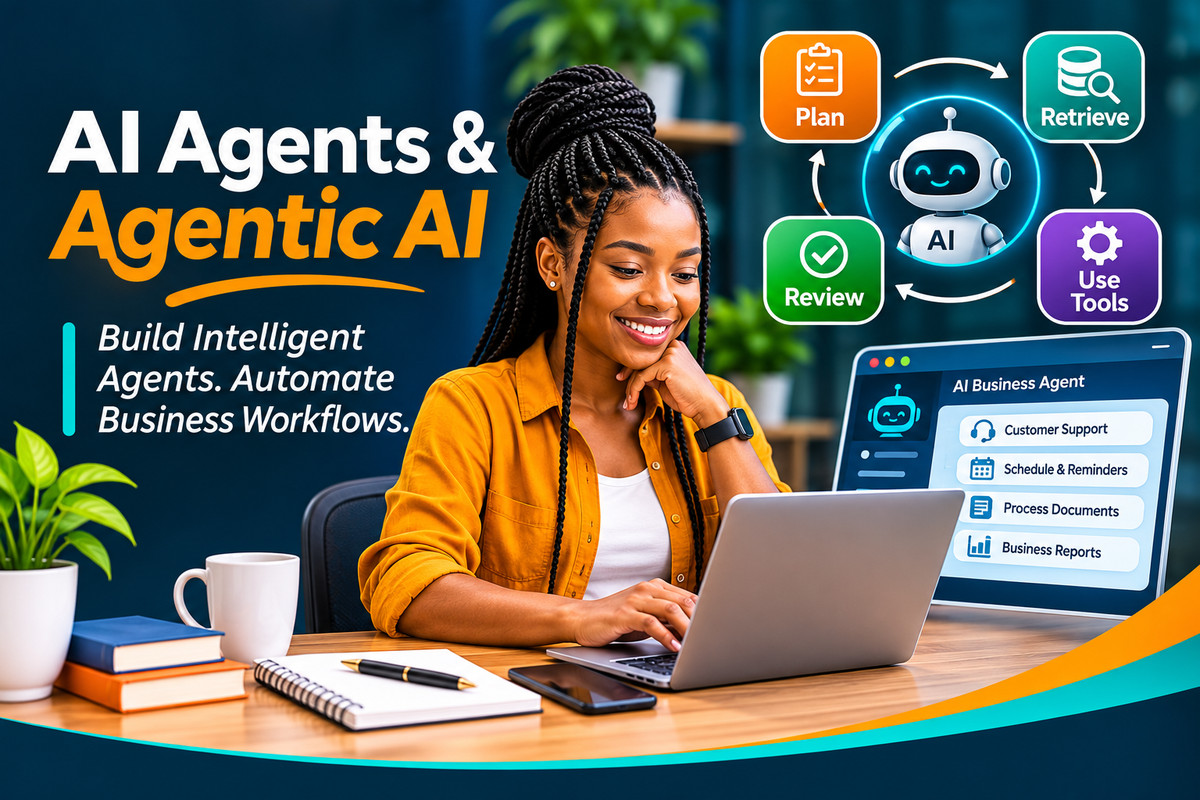
AI Agents and Agentic AI for Beginners
Build Intelligent Business Automation Solutions
Learn to design, configure and evaluate responsible AI agents that use approved knowledge, tools and human oversight to handle realistic small-business questions. Build a private FAQ assistant prototype or well-documented offline simulation—without compulsory video lessons, paid APIs or authentic customer data.
FREE · SELF-PACED · 24 LESSONS · 6 GRADED QUIZZES · PRACTICAL CAPSTONE
Skills you will develop
- Distinguish language models, scripted bots, rule-based workflows and tool-using AI agents.
- Map an agent loop, define objectives, stop conditions and human-approval boundaries.
- Prepare a trustworthy business knowledge base and trace answers to approved sources.
- Write and test bounded instructions, safe tool permissions and multi-turn workflows.
- Build a private read-only FAQ prototype or honestly labeled offline workflow simulation.
- Run ten-case evaluations, adversarial safety tests, regression checks and incident scenarios.
- Document a professional agent case study, handover guide and maintenance plan.
Six-module roadmap
MODULE 01
AI Agents, Agentic AI and Practical Use Cases
Distinguish AI agents from chatbots and conventional automation, identify useful work and establish safe limits.
MODULE 02
Agent Architecture: Instructions, Knowledge, Tools and Memory
Design reliable inputs, trusted knowledge, tool permissions, state and human review.
MODULE 03
Designing Business Agents and Agent Experiences
Turn a real business need into an agent specification, conversation design and acceptance criteria.
MODULE 04
Building a No-Code AI Agent Prototype
Build a controlled customer-support agent using accessible tools or an offline decision-workflow alternative.
MODULE 05
Testing, Integrations, Reliability and Security
Evaluate quality, apply permissions, test failure cases and document safe improvement.
MODULE 06
Client Delivery, Portfolio and Responsible Operations
Prepare professional handover, maintenance plans, pricing logic and an evidence-based portfolio.
Final practical project
Build a support-agent prototype for fictional Jirani Bike Repair. Submit a scoped business brief, approved FAQ, tool/permission matrix, agent instructions, human-handoff design, ten test runs, safety review and a client-facing portfolio case study. A private sandbox or clearly labeled offline simulation is accepted; an automated quiz score does not verify the practical project.
Who should enroll?
Beginner learners interested in practical AI, digital work, customer support, technology entrepreneurship and careful automation. Basic internet browsing and document editing are enough to begin; a laptop is recommended for tool experiments. No programming, live customer data, API credits or commercial subscriptions are required for core assessments.
Study format and assessment
Independent reading and guided exercises, approximately 20–24 learning hours. Twenty-four designed lessons plus the capstone, six native LearnPress quizzes with ten questions each and an intended 80% passing grade. Practical competence requires a separate reviewer or configured assignment process; completion certificates depend on your website settings.
Responsible deployment
AI agents can hallucinate, follow malicious content, fail when tools are unavailable and create harm through excessive permissions. This course uses made-up business records, read-only information and explicit human review. A classroom prototype must not be advertised as a secure or legally compliant production assistant without additional testing and approvals.
Common questions
Must I purchase an AI subscription?
No. Core exercises have a documented spreadsheet/decision-workflow alternative; optional builder features and quotas may require separate costs.
Is a prompt-only chatbot the same as an agent?
No. Agents are characterized by their design for multi-step goals, context, tools and bounded decisions; the exact implementation matters.
Can I use real customer records?
No. Use fictional records for this course unless a separate authorized live project has undergone appropriate privacy and security review.
Will my prototype send customer messages or book appointments?
No. External actions are simulated or drafted; the learning project does not enable unapproved writes.
Will the course guarantee employment?
No. It builds portfolio evidence and foundational skills, but jobs and client contracts are not guaranteed.
Are practical assignments automatically marked by quizzes?
No. Human review or a separately configured project submission workflow is necessary.
HEAL CREC · Digital Skills for Employment & Entrepreneurship · HEAL-AGT-006
Curriculum
Curriculum
- 6 Sections
- 25 Lessons
- Lifetime
- Module 1: AI Agents, Agentic AI and Practical Use Cases5 ItemsDistinguish AI agents from chatbots and conventional automation, identify useful work and establish safe limits.
- 1.1From Chatbots to AI Agents: What Changes?45 Minutes
- 1.2Identifying Useful and Safe Business Agent Opportunities45 Minutes
- 1.3How an Agent Loop Actually Operates45 Minutes
- 1.4Data Privacy, Limitations and Responsible AI45 Minutes
- 1.5Module 1 Assessment: AI Agents, Agentic AI and Practical Use Cases30 Minutes10 Questions
- Module 2: Agent Architecture: Instructions, Knowledge, Tools and Memory5 ItemsDesign reliable inputs, trusted knowledge, tool permissions, state and human review.
- 2.1Writing Agent Instructions That Can Be Tested45 Minutes
- 2.2Preparing a Reliable Business Knowledge Base45 Minutes
- 2.3Tools, Permissions and the Difference Between Read and Write45 Minutes
- 2.4Memory, Context and Multi-Step Task State45 Minutes
- 2.5Module 2 Assessment: Agent Architecture: Instructions, Knowledge, Tools and Memory30 Minutes10 Questions
- Module 3: Designing Business Agents and Agent Experiences5 ItemsTurn a real business need into an agent specification, conversation design and acceptance criteria.
- 3.1Turning a Business Problem Into an Agent Brief45 Minutes
- 3.2Designing Conversation Routes and Human Handoffs45 Minutes
- 3.3Planning Source Retrieval and Response Grounding45 Minutes
- 3.4Creating a Test Plan Before Building45 Minutes
- 3.5Module 3 Assessment: Designing Business Agents and Agent Experiences30 Minutes10 Questions
- Module 4: Building a No-Code AI Agent Prototype5 ItemsBuild a controlled customer-support agent using accessible tools or an offline decision-workflow alternative.
- 4.1Choosing a No-Code Tool and Defining a Fallback45 Minutes
- 4.2Building the First FAQ Assistant45 Minutes
- 4.3Adding Knowledge Search and Confidence Controls45 Minutes
- 4.4Handling Escalation and Multi-Turn Customer Requests45 Minutes
- 4.5Module 4 Assessment: Building a No-Code AI Agent Prototype30 Minutes10 Questions
- Module 5: Testing, Integrations, Reliability and Security5 ItemsEvaluate quality, apply permissions, test failure cases and document safe improvement.
- 5.1Testing Agent Accuracy and Hallucination Risk45 Minutes
- 5.2Prompt Injection, Secrets and Unsafe Tool Requests45 Minutes
- 5.3Tool Failures, Human Approval and Operational Monitoring45 Minutes
- 5.4Privacy, Compliance and Release Readiness45 Minutes
- 5.5Module 5 Assessment: Testing, Integrations, Reliability and Security30 Minutes10 Questions
- Module 6: Client Delivery, Portfolio and Responsible Operations6 ItemsPrepare professional handover, maintenance plans, pricing logic and an evidence-based portfolio.
- 6.1Documenting a Client-Ready Agent Demonstration45 Minutes
- 6.2Writing a Service Proposal and Realistic Quote45 Minutes
- 6.3Maintaining Agent Quality and Version Control45 Minutes
- 6.4Finding Legitimate Work and Developing Your Agent Portfolio45 Minutes
- 6.5Capstone: Build and Test a Responsible Business AI Agent180 Minutes
- 6.6Module 6 Assessment: Client Delivery, Portfolio and Responsible Operations30 Minutes10 Questions
Requirements
- Basic browser skills, document editing and reliable access to the learning materials.
- A laptop is useful for optional tool exercises; a smartphone works for reading and worksheets.
- All practice uses fictional business data; never upload private records or credentials.
- No paid APIs, client integrations, account funding or video sessions are required.
Features
- 24 Classic Editor written lessons across six modules; one assessed capstone.
- Six native quizzes with 60 original graded multiple-choice questions.
- Build a private read-only business FAQ agent or accurately labeled simulation.
- Editable knowledge, testing, risk and proposal worksheets plus a portfolio guide.
- No videos, real customer data, unapproved actions or mandatory paid API.
Target audiences
- Young adults developing practical AI, digital support and entrepreneurship skills.
- Beginner freelancers interested in safe agent configuration and knowledge preparation.
- Small-business staff exploring customer service documentation and AI prototyping.
- Learners who want testable portfolio results rather than exaggerated automation claims.
Course Features
- Lectures 25
- Quizzes 6
- Duration Lifetime access
- Skill level Beginner
- Language English
- Students 0
- Certificate No
- Assessments Yes